

HALEU - American Infrastructure & Forgings
HALEU Infrastructure Is a National Imperative. Forging Production Can Determine How Fast It Scales.
High-Assay Low-Enriched Uranium (HALEU) is no longer a future concept. It is the enabling fuel for advanced reactors, small modular reactors and next-generation nuclear deployment. Billions of dollars in public and private capital are flowing into HALEU production. Enrichment providers are expanding centrifuge cascades. Reactor developers are finalizing designs dependent on reliable HALEU supply. Yet one reality remains underdiscussed, HALEU deployment is not limited by reactor design alone. It is constrained by industrial infrastructure…and industrial infrastructure depends on forgings.
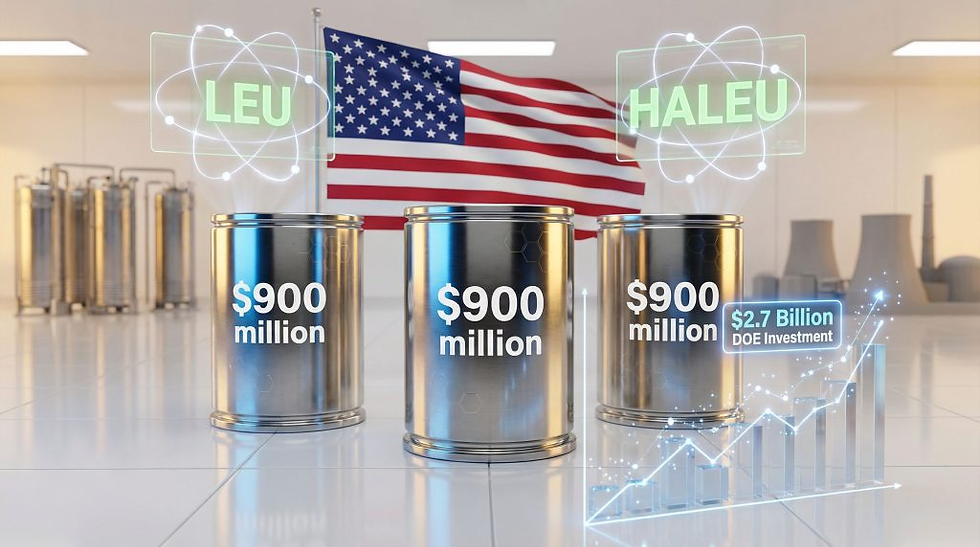
HALEU is an Engineering Challenge. It Is Also a Mechanical Integrity Challenge.
Producing HALEU requires enrichment systems that operate at higher performance thresholds than those used in traditional LEU (low-enriched uranium) production. Centrifuge systems must maintain extreme rotational stability. Structural assemblies must withstand sustained cyclic stress. Containment systems must meet uncompromising regulatory scrutiny. At the center of these systems are forged components:
· Rotor containment rings
· High-speed shafts
· Structural load-bearing assemblies
· Pressure boundary components
· Heavy wall rings and precision flanges
These are not interchangeable machine parts. They are failure-intolerant components operating in high-consequence environments. In HALEU infrastructure, grain structure is not theoretical. It is operational risk management.
The Quiet Bottleneck in HALEU Expansion
The nuclear sector often focuses on regulatory approval, enrichment technology and fuel qualification. Those are essential. But large-scale deployment introduces another constraint…industrial scalability. HALEU expansion requires forging partners capable of:
· Procuring large volumes of nuclear-grade ingot
· Producing components across a broad weight range
· Maintaining repeatable metallurgical consistency
· Delivering near-net shapes to reduce machining bottlenecks
· Supporting documentation aligned with nuclear audit standards
Few forging operations possess the purchasing power, press capacity and in-house metallurgy required to meet these demands at scale. Scot Forge is one of those few. With more than 130 years of experience and the ability to produce forgings from 5 pounds to more than 400,000 pounds, the company operates across one of the broadest size ranges in North America. As the largest procurer of ingots in the region, Scot Forge offers material access and supply continuity that directly aligns with HALEU expansion needs. As HALEU production moves from pilot to sustained commercial output, the supply base will determine the speed of deployment.
Forging as a Strategic Infrastructure Lever
Forging has historically been viewed as a downstream procurement activity. In the HALEU era, that perspective is shifting. Mechanical integrity directly impacts:
· Centrifuge up-time
· Maintenance cycles
· Regulatory compliance
· Insurance risk
· Capital efficiency
· National fuel security
Infrastructure reliability begins at the material level. Forging partners must control:
· Melt-to-finish traceability
· Heat treatment precision
· Grain refinement
· Mechanical property verification
· Non-destructive and destructive testing
Scot Forge integrates these capabilities under one roof, combining in-house metallurgy expertise with both destructive and non-destructive testing. This consolidation strengthens documentation integrity, reduces qualification friction and minimizes reliance on fragmented quality systems. Without that level of integration, nuclear infrastructure becomes dependent on disconnected processes. That fragmentation introduces risk.
The Difference Between Capacity and Capability
HALEU expansion is not simply about having a large press. It is about having:
· Depth of metallurgical expertise
· Engineers who understand nuclear applications
· Quality systems designed for high-risk, high-consequence industries
· In-house testing rather than outsourced validation
· Stability in raw material procurement
Scot Forge’s model reflects this distinction. Our combination of scale, technical expertise and vertically integrated capabilities enables consistency across both small and extremely large components, which is critical in high-consequence environments. In nuclear energy, consolidation of expertise is not convenience. It is risk reduction.
Near Net Shaping as a Deployment Accelerator
HALEU programs are operating under aggressive timelines. Reactor developers and enrichment providers cannot afford extended machining queues or inconsistent lead times. Near-net shaped forgings and precision rolled rings offer:
· Reduced downstream machining
· Improved concentricity and grain alignment
· Shortened production cycles
· Improved material utilization
These are core capabilities within Scot Forge’s offering, allowing customers to move from raw material to finished component more efficiently. When enrichment cascades scale into thousands of units, incremental efficiency gains compound into meaningful deployment acceleration, and forging geometry influences reactor timelines more than many realize.
HALEU, Executive Visibility and Infrastructure Risk
At the executive level within enrichment organizations, HALEU is no longer a research initiative – it is a strategic growth engine tied to national policy and international energy positioning. With that visibility comes scrutiny. Mechanical failure, supply interruption or documentation gaps are no longer isolated operational issues, they are board-level concerns. Forging partners that understand this shift operate differently. These forgers build systems around:
· Audit readiness
· Traceability transparency
· Long-term production continuity
· Strategic collaboration rather than transactional supply
This is where companies like Scot Forge move beyond the role of supplier and into the role of an infrastructure partner.
The Path Forward for HALEU Infrastructure
Advanced reactors depend on HALEU…HALEU depends on enrichment scalability…Enrichment scalability depends on mechanical integrity. And, forging sits at the foundation of that chain. As HALEU production expands in North America and allied nations, the forging supply base must match the ambition of reactor developers and enrichment providers. The next decade of nuclear growth will not be defined solely by innovation in reactor design. It will be defined by the strength, stability and scalability of the industrial partners supporting it. In that landscape, forging capacity is not background manufacturing – it is strategic infrastructure.



Comments